LACTIC ACID BACTERIA FROM TOFU WASTEWATER AGAINST Staphylococcus aureus
DOI:
https://doi.org/10.33992/meditory.v14i1.4736Keywords:
lactic acid bacteria, tofu wastewater, antibacterial activity, Staphylococcus aureusAbstract
Background: Staphylococcus aureus is a pathogenic bacterium that causes skin infections and has been reported to develop resistance to antibiotics. Lactic acid bacteria, which can be isolated from tofu wastewater, have the potential to serve as natural antimicrobial agents through the production of bacteriocins, organic acids, hydrogen peroxide, and carbon dioxide.
Objective: To evaluate the antibacterial activity of lactic acid bacteria isolates from tofu wastewater against Staphylococcus aureus.
Methods: This descriptive analytic study used purposive sampling. Tofu wastewater samples were collected from 20 tofu factories in Klungkung District. Lactic acid bacteria were isolated on de Man, Rogosa, and Sharpe media, identified through catalase test, Gram staining, and fermentation type test, and tested for antibacterial activity against Staphylococcus aureus using the well diffusion method.
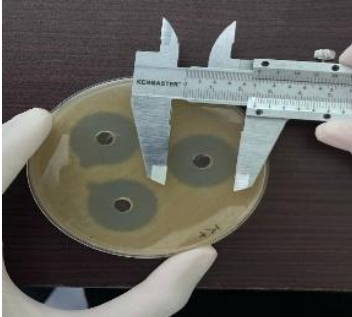
Results: A total of 22 isolates of lactic acid bacteria were obtained, characterized as catalase-negative, Gram-positive, with bacilli and cocci morphology, and homofermentative properties. All isolates exhibited antibacterial activity against Staphylococcus aureus with an average inhibition zone diameter of 8.97 mm, categorized as moderate to strong.
Conclusions: Lactic acid bacteria isolated from tofu wastewater demonstrated antibacterial activity against Staphylococcus aureus and have potential as natural antimicrobial agents.
References
1. Lestari R. Hubungan Sanitasi Lingkungan Dengan Gejala Penyakit Kulit Di Wilayah Kerja Puskesmas Sukamenanti Kabupaten Pasaman Barat. Nan Tongga Health Nurs J. 2022;17(1):14–23.
2. Suyasa IBO, Mastra N. Gambaran Methicillin-Resistant Staphylococcus aureus (MRSA) Pada Petugas Kesehatan RSUD Wangaya Kota Denpasar. Meditory J Med Lab. 2020;8(1):46–52. https://doi.org/10.33992/m.v8i1.1074
3. Rungelrath V, DeLeo FR. Staphylococcus aureus, Antibiotic Resistance, And Interaction With Human Neutrophils. Annu Rev Microbiol. 2021;75:459–479. https://pubmed.ncbi.nlm.nih.gov/32460514/
4. Gunawan IAA, Dewi SS, Wilson W. Aktivitas Kefir dan Isolat Bakteri Asam Laktat dari Kefir Dalam Menghambat Pertumbuhan Staphylococcus aureus. Pros Semin Nas Mhs Unimus. 2018;1:190–196. http://repository.unimus.ac.id/id/eprint/3287
5. Adeniyi BA, Adetoye A, Ayeni FA. Antibacterial Activities Of Lactic Acid Bacteria Isolated From Cow Faeces Against Potential Enteric Pathogens. Afr J Biomed Res. 2015;18(2):123–130. https://doi.org/10.4314/ahs.v15i3.24
6. Karyawati AT, Darmakusuma D, Mauboy R, Amalo D, Mutis A. Potensi Bakteri Asam Laktat sebagai Penghasil Senyawa Antibakteri dan Enzim Ekstraseluler. J Biotropik Sains. 2024;21(2):56–65.
7. Yudhistira B, Andriani M, Utami R. Karakterisasi Limbah Cair Industri Tahu dengan Koagulan yang Berbeda (Asam Asetat Dan Kalsium Sulfat). Caraka Tani J Sustain Agric. 2018;31(2):137–146. https://doi.org/10.20961/carakatani.v31i2.11998
8. Sanjaya M, Safruddin S, Purba DW. Pengaruh Jarak Tanam dan Pemberian Dosis Limbah Cair Tahu Terhadap Pertumbuhan dan Produksi Tanaman Kacang Tanah (Arachis hypogaea L.). Bernas. 2020;14(2):134–146. https://doi.org/10.36294/br.v15i1.476
9. Yeni, Meryandini A, Sunarti TC. The Use of Tofu Whey for Biomass Production by Pediococcus pentosaceus E.1222. J Teknol Ind Pertanian. 2016;26(3):284–293.
10. Khuriyah FA, Nabila AS, Billah M, Nandini A. Pengolahan Limbah Cair Industri Tahu secara Aerob Menggunakan Lumpur Aktif. Semin Nas Soebardjo Brotohardjono. 2023;19(1):124–130.
11. Okfrianti Y, Darwis D, Pravita A. Lactobacillus plantarum C410LI dan Lactobacillus Rossiae LS6 dari Lemea Rejang sebagai Kandidat Probiotik. J Ilmu Teknol Kesehat. 2018;6(1):49–58.
12. Rasyid B, Sandi KM, Sudarmanto IG, Karta IW. Isolasi Dan Uji Aktivitas Antimikroba Bakteri Asam Laktat dari Blondo Virgin Coconut Oil terhadap Staphylococcus aureus. Biomedika. 2021;13(1):56–67. http://repository.poltekkes-denpasar.ac.id/id/eprint/8093
13. Hamidah MN, Rianingsih L, Romadhon R. Aktivitas Antibakteri Isolat Bakteri Asam Laktat dari Peda Terhadap E. coli dan S. aureus. J Ilmu Teknol Perikan. 2019;1(2):11–21. https://doi.org/10.14710/jitpi.2019.6742
14. Riadi S, Situmeang SM, Musthari M. Isolasi dan Uji Aktivitas Antimikroba Bakteri Asam Laktat dari Yoghurt. J Biosains. 2017;3(3):144–150. https://doi.org/10.24114/jbio.v3i3.8302
15. Putri YW, Putra AE, Utama BI. Identifikasi dan Karakteristik Bakteri Asam Laktat dari Vagina Wanita Usia Subur. J Kesehat Andalas. 2018;7(Suppl 3):20–28. https://doi.org/10.25077/jka.v7i0.864
16. Rahmiati, Simanjuntak HA. Kemampuan Bakteri Asam Laktat Dalam Menghambat Salmonella typhi. Sustain. 2019;6(2):257–264. https://doi.org/10.34007/jns.v1i3.25
17. Santosa EA, Retnaningrum E. Karakterisasi Fenotipik dan Aktivitas Antimikrobia Bakteri Asam Laktat dari Limbah Produksi Tempe. J Sains Dasar. 2021;9(1):1–10. https://doi.org/10.21831/jsd.v9i1.34486
18. Sumual AM, Fatimawali, Tallei TE. Uji Antibakteri Bakteri Asam Laktat dari Fermentasi Selada Romaine (Lactuca sativa var. longifolia Lam.). Pharmacon. 2019;8(2):306–314. https://doi.org/10.35799/pha.8.2019.29296
19. Dwijastuti NMS. Eksplorasi Bakteri Asam Laktat sebagai Kandidat Probiotik dengan Aktivitas Antibakteri. J Analis Kesehatan. 2023;12(1):39–45.
20. Abidin Z, Mudi L, Rusmini, et al. Isolation and Characterization of Lactic Acid Bacteria From Rice Washing Water Waste. Int J Sci Technol Manag. 2024;5(1):184–191. 10.46729/ijstm.v5i1.1031
Downloads
Published
Issue
Section
Citation Check
License
Copyright (c) 2026 Ni Made Anggun Ciptasari, Ni Nyoman Astika Dewi, I Gusti Agung Dewi Sarihati

This work is licensed under a Creative Commons Attribution-ShareAlike 4.0 International License.
- Articles published in Meditory are licensed under Creative Commons Attribution-ShareAlike 4.0 International license. You are free to copy, transform, or redistribute articles for any lawful purpose in any medium, provided you give appropriate credit to the original author(s) and Meditory, link to the license, indicate if changes were made, and redistribute any derivative work under the same license.
- Copyright on articles is retained by the respective author(s), without restrictions. A non-exclusive license is granted to Meditory to publish the article and identify itself as its original publisher, along with the commercial right to include the article in a hardcopy issue for sale to libraries and individuals.
- By publishing in Meditory, authors grant any third party the right to use their article to the extent provided by the Creative Commons Attribution-ShareAlike 4.0 International license.