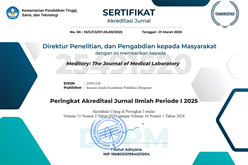
SERTIFIKAT

Research Articles present original and significant findings in the field of medical laboratory science. Manuscripts should report original research using appropriate scientific methods and provide a comprehensive interpretation of the findings.
Recommended length: 3,000–4,500 words, maximum 15 pages, including tables and figures.
Structure:
Title – Author Names and Affiliations – Corresponding Author Information – Abstract – Keywords – Introduction – Research Methods – Results and Discussion – Limitations – Conclusions – Conflict of Interest – Author Contributions – Acknowledgments – Funding – Declaration of Artificial Intelligence Use – References.
Research involving humans, animals, biological specimens, or medical records must comply with the journal's research ethics requirements.
Review Articles provide a comprehensive, critical, and scientifically structured synthesis of current knowledge on topics relevant to medical laboratory science and related biomedical fields.
Meditory accepts systematic reviews, scoping reviews, and narrative reviews, provided that the review demonstrates a clear scientific rationale, appropriate literature selection, critical analysis, and relevance to the journal's scope.
Recommended length: 3,500–6,000 words, excluding references.
Structure:
Title – Author Names and Affiliations – Corresponding Author Information – Abstract – Keywords – Introduction – Review Methods/Literature Search Strategy – Main Review Sections/Results and Discussion – Limitations – Conclusions – Conflict of Interest – Author Contributions – Acknowledgments – Funding – Declaration of Artificial Intelligence Use – References.
For systematic and scoping reviews, authors should clearly describe the search strategy, databases, eligibility criteria, study selection process, and methods of evidence synthesis. Appropriate reporting guidelines should be followed where applicable.
Case Reports describe unusual, novel, or educational clinical or laboratory cases that provide important insights into diagnosis, laboratory investigation, disease mechanisms, or medical laboratory practice.
The report should clearly explain the scientific or educational significance of the case and should not merely describe a routine clinical finding.
Recommended length: 1,500–3,000 words.
Structure:
Title – Abstract – Keywords – Introduction – Case Presentation – Laboratory Investigations – Discussion – Conclusion – Conflict of Interest – Author Contributions – Acknowledgments – Funding – Declaration of Artificial Intelligence Use – References
Authors must protect patient confidentiality. Written informed consent for publication must be obtained from the patient or their legal representative where applicable. Identifying information must not be published unless scientifically essential and appropriately consented to.
Letters to the Editor provide concise scientific comments, critiques, discussions, or responses concerning articles published in Meditory or other issues relevant to medical laboratory science.
Letters should present a focused argument supported by appropriate scientific evidence and should be written in a professional and constructive manner.
Recommended length: 500–1,500 words.
Structure:
A formal abstract is generally not required. The manuscript may consist of a Title – Main Text – Conflict of Interest – Author Contributions – Acknowledgments – Funding – Declaration of Artificial Intelligence Use – References
Letters commenting on a published Meditory article should clearly identify the article being discussed.
Editorials provide expert perspectives, commentary, or discussion on important developments, emerging issues, policies, or scientific directions relevant to medical laboratory science and the scope of Meditory.
Editorials are generally written by the Editor-in-Chief, members of the Editorial Board, or invited experts. Unsolicited Editorial submissions may be considered at the discretion of the Editor-in-Chief.
Recommended length: 1,000–2,000 words.
Structure:
Title – Main Text – Conclusion – Conflict of Interest – Author Contributions – Acknowledgments – Funding – Declaration of Artificial Intelligence Use – References
A structured abstract is generally not required . Editorials should be concise, evidence-based, and appropriately referenced where necessary.
GENERAL MANUSCRIPT REQUIREMENTS
LANGUAGE (USAGE AND EDITING SERVICES):
Please compose your manuscript proficiently. American and British English usage is acceptable, but avoid a combination of these styles. Authors who are concerned about potential grammatical or spelling errors in their English language manuscript and wish to ensure alignment with correct scientific English may consider utilizing English Language Editing services.
ARTICLE STRUCTURE
A.Writing Format Requirements:
B.Page Limitation:
The manuscript should not exceed a maximum of 15 pages
C. Citations and Bibliography:
D. Essential Title Page Information for Meditory Journal
E.Abstract
The abstract consists of 150-200 words written in a single paragraph. It should be clear, informative, and descriptive, and it should clearly state the problem and the proposed approach or solution and point out major findings and conclusions. The abstract should be written in the past tense. Standard nomenclature should be used, and abbreviations should be avoided. No literature should be cited. The abstract should be accompanied by relevant keywords or brief phrases related to the paper, with a maximum of 5 keywords.
F. Introduction
Provide a detailed explanation of the scientific background and rationale for the research. Support your explanation with relevant and recent data. Clearly express the background of the problem. Explicitly state the problem's formulation. Highlight relevant literature, emphasizing distinctions from prior or similar research conducted by other researchers. Ensure clarity, making the raised issues understandable to the scientific community.
G. Research Methods
Explain the chronology/stages of the study, including the research design, research procedures, sampling method, and data analysis method. Tables and figures should be presented in the center, as shown at the bottom of this template, and should include sources of tables and figures, whether from primary data or secondary data.
H. Results and Discussions
This section explains the results of the research and, at the same time, also conducts a comprehensive discussion. Results can be presented in the form of figures, graphs, tables, and others so that readers can easily understand them, but images must be compressed first so that the file sent is not too large. The discussion can also be made separately in the sub-section point
I. Conclusions
The conclusion answers the research aims but can also add further research development based on the results and discussions.
J. References
References come from primary sources (scientific articles, theses, theses, dissertations). Specifically for scientific articles, there are at least (electronic) scientific journal articles with active links (DOI or URL). All citations referred to in the manuscript must be written in the bibliography so that a reference manager is needed. The minimum literature used in the manuscript is within 10 years when the research was conducted. Please ensure that every reference cited in the text is also present in the reference list (and vice versa).
K. Acknowledgments
Compile acknowledgments in a separate section at the end of the article before the references, and therefore, do not include them on the title page as a footnote to the title or otherwise. List individuals here who provided assistance during the research (e.g., offering language help, providing writing assistance, or proofreading the article, etc.).
L. Math Formulas
Submit mathematical equations as editable text and not as images. Present simple formulas in line with normal text where possible and use the solidus (/) instead of a horizontal line for small fractional terms, for example, X/Y. In principle, variables should be presented in italics. Powers of e are often more conveniently denoted by "exp." Number consecutively any equations that need to be displayed separately from the text (if explicitly referred to in the text).
M. Table
Please send the tables in an editable text format rather than as images. Tables can be placed either next to the relevant text in the article or on separate pages at the end. Number the tables consecutively in accordance with their appearance in the text and place any table notes below the table body. Use tables sparingly and ensure that the data presented in them do not duplicate results described elsewhere in the article. Please avoid using vertical lines.
N. Picture
Ensure that the images have captions written separately at the bottom, not attached to the images. A caption should consist of a brief title (not on the image itself) and a description of the illustration. Provide sequential numbers for the images in accordance with their appearance in the text.
PLAGIARISM CHECK
All submitted articles to Meditory will undergo an initial screening using TURNITIN to check for plagiarism, employing a similarity index. The papers submitted must have a similarity level of no more than 20%. Any articles exceeding a 20% similarity index will be rejected without undergoing further peer-review. In such cases, authors will be advised to revise and resubmit the manuscript. Meditory strictly prohibits plagiarism and fraudulent data, maintaining a commitment to upholding the highest standards of integrity in the journal.
Authors must upload all required files through the Online Journal System (OJS) at the time of manuscript submission. A submission may be returned to the authors or may not proceed to the editorial screening process if the required documents are incomplete.
The following files are required:
Important: Submissions with incomplete mandatory files may be returned to the authors for completion before proceeding to editorial assessment and peer review.
Published by:
Meditory: The Journal of Medical Laboratory
Poltekkes Kemenkes Denpasar
Email: meditoryjournal@poltekkes-denpasar.ac.id
ONLINE-ISSN: 2549-1520 , PRINT-ISSN : 2338-1159

This work is licensed under a Creative Commons Attribution-ShareAlike 4.0 Generic License .