
Peer Review Policy

All manuscripts submitted to Meditory: The Journal of Medical Laboratory undergo a rigorous editorial screening and peer-review process to ensure that they are within the journal's aims and scope and meet appropriate standards of scientific quality, originality, methodological rigor, ethical compliance, and relevance to the field.
Meditory employs a double-blind peer-review process, in which the identities of both the authors and reviewers are concealed from each other throughout the review process. Manuscripts that successfully pass the initial editorial screening and Section Editor assessment are assigned to at least two independent reviewers with expertise relevant to the subject of the manuscript.
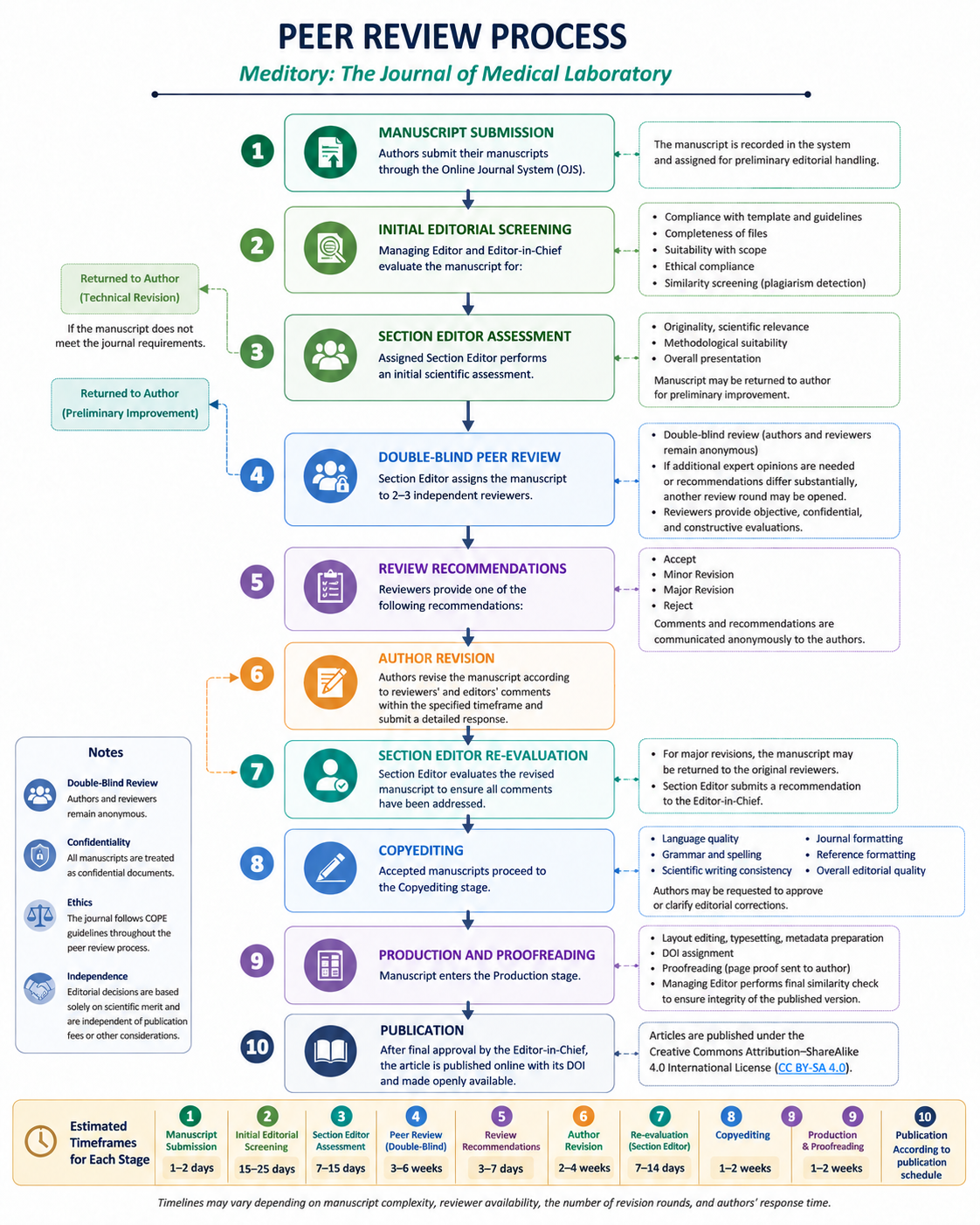
The editorial and peer-review process consists of the following stages:
- Manuscript Submission. Authors submit their manuscripts through the Online Journal System (OJS). The submitted manuscript is recorded in the system and assigned for preliminary editorial handling.
- Initial Editorial Screening. The Managing Editor and Editor-in-Chief evaluate the manuscript for compliance with the journal's template and author guidelines, completeness of required files, suitability within the journal's aims and scope, ethical compliance, and similarity screening. Manuscripts that do not meet the journal's requirements may be returned to the authors for technical revision or rejected without external peer review.
- Section Editor Assessment. Manuscripts that pass the initial screening are assigned to a Section Editor for an initial scientific assessment, including originality, scientific relevance, methodological suitability, and overall presentation. The manuscript may be returned to the authors for preliminary improvement before proceeding to external peer review.
- Double-Blind Peer Review. The Section Editor assigns the manuscript to at least two independent reviewers with relevant expertise. The identities of both authors and reviewers remain concealed from each other. If additional expert opinions are required or reviewer recommendations differ substantially, an additional reviewer or review round may be requested.
- Review Recommendations. Reviewers evaluate the manuscript and provide comments and recommendations, which may include Accept Submission, Minor Revision, Major Revision, or Decline Submission. Reviewer comments and recommendations are communicated anonymously to the authors.
- Author Revision. When revisions are required, authors are requested to revise the manuscript according to the reviewers' and editors' comments and submit a detailed point-by-point response within the specified timeframe.
- Section Editor Re-evaluation. The Section Editor evaluates the revised manuscript to determine whether the reviewers' and editors' comments have been adequately addressed. For major revisions, the manuscript may be returned to the original reviewers for further evaluation. The Section Editor subsequently submits a recommendation to the Editor-in-Chief.
- Copyediting. Manuscripts approved for publication proceed to copyediting, which includes language and grammar checking, scientific writing consistency, journal formatting, and reference formatting. Authors may be requested to review or clarify editorial corrections.
- Production and Proofreading. Accepted manuscripts undergo layout editing, typesetting, metadata preparation, DOI assignment, and proofreading. Page proofs may be provided to the corresponding author for final checking before publication.
- Publication. Following final approval by the Editor-in-Chief, the article is published online with its assigned DOI and made openly available in accordance with the journal's open-access and licensing policies.
The final decision regarding the acceptance or rejection of a manuscript rests with the Editor-in-Chief, based on the reviewers' reports, the authors' responses, and the recommendation of the Section Editor. Editorial decisions are based solely on scientific merit, ethical compliance, and relevance to the journal's aims and scope.
Estimated timeframes for each stage are provided in the Peer Review Process diagram below. These timeframes may vary depending on manuscript complexity, reviewer availability, the number of revision rounds, and the authors' response time.