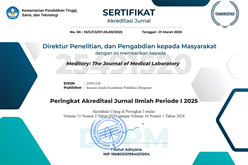
SERTIFIKAT

The Meditory Journal acknowledges the rapid development and growing role of Artificial Intelligence (AI) and AI-based technologies in research and scientific publication.
As an academic journal, Meditory is committed to maintaining transparency, scientific integrity, and academic honesty by providing clear guidance for authors, editors, reviewers, and contributors regarding the ethical use of AI.
This policy is formulated in accordance with the guidelines of the Committee on Publication Ethics (COPE) and international publication ethics standards.
a. Use of AI in Manuscript Preparation
Meditory recognizes the use of generative AI and AI-assisted tools (such as ChatGPT, Grammarly, QuillBot, etc.) in manuscript preparation, provided that such use remains supportive and under full human supervision.
AI tools may be used to improve clarity, structure, or linguistic quality, but must not be used to generate scientific ideas, analyze data, or draw research conclusions independently.
Authors are fully responsible for reviewing and editing all AI-generated or AI-assisted text to ensure its accuracy, completeness, and objectivity.
b. Authorship
AI systems or AI-based tools cannot be listed as authors or co-authors and cannot be cited as such.
Only individual humans who meet the authorship criteria set by the International Committee of Medical Journal Editors (ICMJE) may be recognized as authors.
Human authors bear full responsibility for the originality, accuracy, and scientific integrity of the entire manuscript.
a. Prohibition of Visual Manipulation
Generative AI tools must not be used to create or modify images, figures, or illustrations in submitted manuscripts, except for minor adjustments (e.g., brightness, contrast, or color balance) that do not alter the original meaning or data.
b. Exceptions for Research Methodology
If the use of AI is an integral part of the research methodology (e.g., AI-assisted image analysis in medical or biotechnological studies), such use must be described in detail and reproducible in the Methods section.
Authors must specify the software name, version, and usage license, ensuring compliance with the AI tool’s terms of use.
c. Artistic Works and Cover Illustrations
The creation of artistic content using AI—including graphical abstracts or cover art—is not permitted without written approval from the Editor-in-Chief.
If approved, authors must provide clear attribution and ensure no copyright or ethical violations occur.
a. Disclosure of AI Involvement
Any use of AI in writing, analysis, or visualization must be transparently disclosed in the Acknowledgment or Methods section.
Suggested disclosure statement:
“Portions of this manuscript were prepared using generative AI tools (e.g., ChatGPT, OpenAI) for language assistance and have been thoroughly reviewed and verified by the human authors.”
b. Ethical Research Compliance
Authors must ensure that the use of AI complies with principles of data privacy, copyright, research integrity, and that any datasets used for AI training are legally obtained and properly attributed.
a. Editorial and Peer Review Process
All submitted manuscripts—whether AI-assisted or not—are subject to rigorous peer review to evaluate scientific validity, originality, and compliance with Meditory’s ethical publication standards.
b. Policy Violations
Manuscripts found to violate this policy may be rejected or required to undergo major revision.
Severe ethical violations may result in article retraction, following COPE guidelines.
Meditory will periodically review and update this policy to align with emerging developments in AI technologies, evolving ethical standards, and applicable national or international regulations.
Published by:
Meditory: The Journal of Medical Laboratory
Poltekkes Kemenkes Denpasar
Email: meditoryjournal@poltekkes-denpasar.ac.id
ONLINE-ISSN: 2549-1520 , PRINT-ISSN : 2338-1159

This work is licensed under a Creative Commons Attribution-ShareAlike 4.0 Generic License .