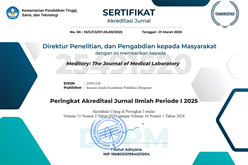
SERTIFIKAT

Meditory: The Journal of Medical Laboratory recognizes the importance of ethical principles in academic publishing and is committed to upholding a high standard of integrity and ethical behavior.
To ensure transparency and ethical conduct throughout the publication process, Meditory adheres to rigorous peer-review standards and follows the COPE (Committee on Publication Ethics) Best Practice Guidelines.
This publication ethics statement establishes clear expectations for all stakeholders, including authors, editors, reviewers, and the publisher (Poltekkes Kemenkes Denpasar).
With this ethical framework, Meditory aims to promote publication ethics and prevent research malpractice among all parties involved in the journal.
Publisher Commitment to Ethical Publishing
The publication of a peer-reviewed article in Meditory is a crucial step in developing a reliable and coherent network of scientific knowledge.
It reflects both the quality of the author’s work and the academic institution that supports it, and it upholds the scientific method.
Therefore, it is essential to establish ethical standards for all parties involved in the publishing process — authors, editors, reviewers, publishers, and society.
As the publisher of Meditory, Poltekkes Kemenkes Denpasar fully recognizes its duty to oversee all stages of publishing and maintain ethical and professional responsibility.
The publisher ensures that editorial decisions remain independent and unbiased, unaffected by commercial influences, advertisements, or sponsorships.
Meditory does not accept any advertising or marketing revenue to guarantee editorial objectivity.
The Editorial Board and the publisher also facilitate communication with other journals and organizations when necessary to uphold academic integrity.
Allegation of Research Misconduct
Research misconduct includes fabrication, falsification, plagiarism, citation manipulation, and other unethical practices during research, peer review, or publication.
Editors are responsible for maintaining the accuracy and integrity of the scientific record.
If misconduct is suspected:
The editorial board will initiate a fair and independent investigation,
The corresponding author will be contacted to provide an explanation,
Expert reviewers may be consulted when necessary,
If evidence confirms misconduct, the manuscript will be rejected or the published article retracted,
In minor cases, clarification or correction may be published.
It is the shared responsibility of authors, editors, reviewers, and institutions to preserve the reliability of the scientific record.
Meditory will continue to uphold publication integrity by applying corrections, retractions, or replacements when necessary.
Authorship and Contributorship
Authorship should accurately reflect each contributor’s role in the research.
Only individuals who have significantly contributed to the conception, design, execution, or interpretation of the study should be listed as authors.
All authors must approve the final version of the manuscript before submission.
Those who provided technical or limited contributions should be acknowledged in a separate acknowledgment section.
All listed authors must have made substantial contributions to the work, approved the final version of the manuscript, and agreed to be accountable for their contributions. Changes to authorship after submission, including addition, removal, or rearrangement of authors, must be approved by all authors and are subject to editorial approval.
Complaints and Appeals
Meditory provides a clear and fair process for handling complaints related to editorial decisions, review procedures, ethical concerns, or publication management.
Complaints may include issues such as:
Bias in editorial or peer review,
Unethical citation practices,
Peer-review manipulation, or
Delays or procedural errors.
All complaints are handled confidentially and in accordance with COPE’s Ethical Guidelines.
Data Access, Retention, and Reproducibility
To ensure transparency and reproducibility of research:
Authors are required to provide the raw data supporting the findings of their study as supplementary material or upon editorial request, subject to ethical, legal, confidentiality, and participant privacy considerations,
Authors must retain data for a reasonable time after publication,
When possible, data should be made publicly accessible for verification and future studies.
Ethical Oversight
Authors must disclose and appropriately address ethical considerations related to research involving human participants, animals, hazardous materials, confidential information, or sensitive data.
Research involving human participants must have received approval from an appropriate institutional ethics committee before the study was conducted. Authors must provide the name of the ethics committee and the approval/reference number in the manuscript. Where applicable, informed consent must be obtained from participants or their legal guardians.
Research involving animals must receive appropriate ethical approval and comply with applicable institutional and national animal welfare guidelines.
Authors must ensure the protection of participants' privacy, confidentiality, and personal data throughout the research and publication process.
Duties of Authors
1. Reporting Standards
Authors must present accurate, complete, and honest reports of their research findings.
Fraudulent or manipulated data are strictly prohibited.
Manuscripts should include sufficient details and references to allow replication.
2. Originality and Plagiarism
Authors must ensure that their submissions are original and not under consideration by other journals.
All sources and previous works must be properly cited.
Direct quotations or paraphrased content must be appropriately referenced.
3. Multiple or Redundant Publications
Authors must not submit the same research to more than one journal or publish overlapping content without disclosure.
If multiple papers arise from a single project, the primary publication must be cited.
4. Acknowledgment of Sources
All data sources, collaborators, and funding bodies must be properly acknowledged.
5. Conflicts of Interest
Authors must disclose all financial, personal, institutional, or other relationships that could reasonably be perceived to influence the research or its interpretation. A Conflict of Interest statement must be included in every manuscript, including a declaration that no conflict exists when applicable.
6. Fundamental Errors in Published Works
If authors discover a significant error in their published article, they must promptly notify the editor and cooperate to issue a correction or retraction.
Duties of Editors
1. Publication Decisions
Editors are responsible for deciding whether a manuscript should be accepted, revised, or rejected based on peer review and editorial judgment.
All decisions must comply with journal policies and ethical standards.
2. Peer-Review Management
Editors ensure that each manuscript undergoes fair and unbiased double-blind peer review by qualified reviewers.
They must maintain confidentiality and manage conflicts of interest appropriately.
3. Fairness and Integrity
Editorial evaluation must be based solely on the academic merit of manuscripts, without discrimination based on gender, religion, ethnicity, or nationality.
4. Confidentiality
Editors must keep all submitted materials confidential and ensure compliance with data protection and patient confidentiality regulations.
5. Conflict of Interest
Editors must not use unpublished materials for their own research and must not handle manuscripts in which they have personal, professional, financial, or institutional conflicts of interest. In such cases, the manuscript must be assigned to another qualified editor.
Duties of Reviewers
1. Contribution to Editorial Decisions
Reviewers assist editors in making publication decisions and in improving the quality of manuscripts.
2. Confidentiality
All manuscripts received for review must be treated as confidential documents.
3. Objectivity and Constructive Feedback
Reviews should be conducted objectively with clear and constructive comments.
4. Acknowledgment of Sources
Reviewers should verify proper citation of relevant literature and report any plagiarism or unethical conduct to the editor.
5. Conflicts of Interest
Reviewers must decline to review manuscripts in which they have conflicts of interest and must not use unpublished data for personal gain.
6. Timeliness
Reviewers must respond to review invitations promptly and meet agreed deadlines.
Intellectual Property (Copyright Policy)
All articles published in Meditory: The Journal of Medical Laboratory are licensed under the
Creative Commons Attribution-ShareAlike 4.0 International License (CC BY-SA 4.0).
Authors retain copyright of their work and grant the journal the right of first publication.
Others may share or adapt the work with proper attribution and under the same license.
Post-Publication Discussions and Corrections
Meditory encourages post-publication discussions and welcomes readers’ comments or corrections.
Readers may send their feedback to the Editor-in-Chief via email.
If accepted, comments will be published as a Letter to the Editor in the following issue, and authors of the original paper will be invited to respond.
Peer-Review Process Policy
Meditory implements a double-blind peer-review system, in which the identities of authors and reviewers are concealed from each other. Manuscripts that pass the initial editorial assessment are evaluated by at least two independent reviewers with relevant expertise.
Manuscripts are evaluated based on scientific originality and relevance, methodological soundness, ethical compliance, quality of data presentation and interpretation, and relevance to the journal's aims and scope.
The final publication decision is made by the Editor-in-Chief, based on the reviewers' reports, the authors' responses, and the recommendation of the Section Editor.
Further information regarding the review stages and estimated timeframes is available on the journal's Peer Review Policy page.
Plagiarism Screening Policy
Meditory maintains a strict policy against plagiarism, self-plagiarism, and inappropriate textual overlap. All submitted manuscripts are screened using Turnitin, and the journal requires a similarity index of less than 20%.
The similarity index is used as a screening tool and does not, by itself, determine whether plagiarism has occurred. Manuscripts containing plagiarism, inappropriate paraphrasing, unattributed use of another person's work, or excessive textual overlap may be returned for revision or rejected regardless of the similarity score.
Authors are responsible for ensuring the originality of their manuscripts and for appropriately citing all sources.
Article Withdrawal, Corrections, and Retractions
Authors are permitted to withdraw their manuscripts before publication by submitting a formal withdrawal letter with valid reasons.
Once accepted or scheduled for publication, withdrawal is only allowed for ethical reasons.
Unethical withdrawal practices may lead to sanctions.
Published articles proven to contain serious errors or misconduct will be corrected or retracted according to COPE guidelines.
Artificial Intelligence (AI) and AI-Assisted Technologies
Meditory: The Journal of Medical Laboratory requires the transparent and responsible use of artificial intelligence (AI) and AI-assisted technologies in research and scholarly publishing. AI tools cannot be listed as authors, and authors remain fully responsible for the accuracy, originality, integrity, and ethical compliance of their manuscripts. The use of generative AI or AI-assisted technologies that materially contributes to manuscript preparation, analysis, interpretation, or presentation must be appropriately disclosed.
Editors and reviewers must protect the confidentiality of submitted manuscripts and must not upload confidential manuscript materials to AI systems when doing so may compromise confidentiality, intellectual property, or data protection. AI tools must not replace independent scientific judgment in peer review or editorial decision-making.
Suspected undisclosed or inappropriate use of AI will be handled in accordance with the journal's publication ethics procedures and relevant COPE guidance.
Publisher and Contact Information
Publisher: Poltekkes Kemenkes Denpasar
Journal Name: Meditory: The Journal of Medical Laboratory
Editor-in-Chief: I Nyoman Jirna
Website: https://ejournal.poltekkes-denpasar.ac.id/index.php/M
Year Established: 2013
Language: English
Publication Type: Peer-reviewed, open access, with APC
Published by:
Meditory: The Journal of Medical Laboratory
Poltekkes Kemenkes Denpasar
Email: meditoryjournal@poltekkes-denpasar.ac.id
ONLINE-ISSN: 2549-1520 , PRINT-ISSN : 2338-1159

This work is licensed under a Creative Commons Attribution-ShareAlike 4.0 Generic License .