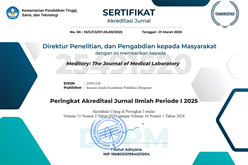
SERTIFIKAT

Meditory: The Journal of Medical Laboratory is committed to maintaining a rigorous, transparent, and fair editorial and peer review process to ensure the scientific quality and integrity of every published article. All submitted manuscripts undergo the following editorial workflow before publication.
Authors submit their manuscripts through the journal's Online Journal System (OJS). Upon submission, the manuscript is recorded and assigned for preliminary editorial handling.
The submitted manuscript is first evaluated by the Managing Editor and the Editor-in-Chief. During this stage, the editorial team assesses:
Manuscripts that do not meet the journal requirements may be returned to the authors for technical revision or rejected before entering the peer review stage.
Manuscripts that successfully pass the initial editorial screening are assigned to an appropriate Section Editor according to the manuscript's subject area.
The Section Editor performs an initial scientific assessment, including the manuscript's originality, scientific relevance, methodological suitability, and overall presentation. When necessary, the manuscript may be returned to the authors for preliminary improvement before external peer review.
Only manuscripts considered scientifically ready proceed to the peer review stage.
The Section Editor assigns the manuscript to two or three independent reviewers using a double-blind peer review system, in which the identities of both authors and reviewers remain anonymous throughout the review process.
If additional expert opinions are required or reviewer recommendations differ substantially, the Section Editor may initiate an additional review round by inviting one or more additional reviewers.
Reviewers are selected based on their expertise and are expected to provide objective, confidential, and constructive evaluations.
After evaluating the manuscript, reviewers provide one of the following recommendations:
Reviewer comments and recommendations are communicated anonymously to the authors through the journal management system.
Authors are requested to revise their manuscript according to the reviewers' and editors' comments within the specified timeframe. A detailed response to reviewers should accompany the revised manuscript.
The revised manuscript is re-evaluated by the assigned Section Editor to ensure that all reviewer comments have been adequately addressed.
For manuscripts requiring major revision, the Section Editor may return the revised manuscript to the original reviewers for further evaluation when necessary.
The Section Editor then submits a recommendation to the Editor-in-Chief regarding the manuscript's suitability for publication.
Accepted manuscripts proceed to the Copyediting stage.
The Copy Editor reviews the manuscript for:
Authors may be requested to approve or clarify editorial corrections before production.
After copyediting is completed, the manuscript enters the Production stage, which includes layout editing, typesetting, metadata preparation, DOI assignment, and proofreading.
The corresponding author receives the page proof for final verification and approval.
Before publication, the Managing Editor performs a final similarity check to ensure the integrity of the published version.
Following successful completion of all editorial and production processes, the Editor-in-Chief grants final approval for publication.
The article is then published online with its DOI and made immediately available under the Creative Commons Attribution–ShareAlike 4.0 International (CC BY-SA 4.0) License as part of Meditory's Open Access policy.
Published by:
Meditory: The Journal of Medical Laboratory
Poltekkes Kemenkes Denpasar
Email: meditoryjournal@poltekkes-denpasar.ac.id
ONLINE-ISSN: 2549-1520 , PRINT-ISSN : 2338-1159

This work is licensed under a Creative Commons Attribution-ShareAlike 4.0 Generic License .