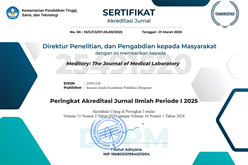
SERTIFIKAT

It is a fundamental principle of scholarly publishing that the editor of an academic journal holds sole and independent responsibility for deciding which submitted articles are suitable for publication. In making this decision, the editor is guided by the policies established by the journal’s editorial board and bound by applicable legal requirements concerning libel, copyright infringement, and plagiarism.
A scholarly journal serves as a permanent record of academic discourse. Therefore, published articles should remain available, accurate, and unaltered as far as possible. However, in rare circumstances, it may become necessary to withdraw, retract, remove, or replace an article after publication. Such actions must be undertaken only under exceptional conditions and with careful consideration.
This policy has been developed to address such situations, taking into account current best practices within the scholarly and library communities. Meditory Journal is committed to periodically reviewing this policy in alignment with evolving international standards and to supporting initiatives that promote global best practices in academic publishing ethics.
We also refer to the National Library of Medicine (NLM) policy on retractions and the recommendations of the International Committee of Medical Journal Editors (ICMJE) concerning corrections and retractions.
Article withdrawal applies only to Articles in Press — those that have been accepted for publication but have not yet been formally published (i.e., do not yet have complete volume, issue, and page information).
Withdrawal may be appropriate in cases where:
The article contains significant errors;
The article is an accidental duplicate of another published work;
The article violates the journal’s ethical publishing standards, such as multiple submission, false authorship claims, plagiarism, or fraudulent data use.
When an article is withdrawn, its HTML and PDF content will be removed and replaced with a statement page indicating that the article has been withdrawn in accordance with the Meditory Journal Article Withdrawal Policy, including a link to this policy document.
Article retraction applies to formally published articles and may occur in cases of serious ethical violations such as:
Multiple submission;
False or disputed authorship;
Plagiarism;
Fabrication or falsification of data;
Major errors that invalidate the article’s findings.
A retraction note, titled “Retraction: [article title]”, will be published in a subsequent issue of the journal, signed by the author(s) and/or editor, and listed in the table of contents.
In the online version, a link will be provided to the original article.
The online article will be preceded by a screen displaying the retraction note, which the reader must acknowledge before accessing the article.
The original article will remain accessible but will be watermarked “Retracted” on every page of the PDF.
The HTML version of the article will be removed.
The retraction process follows the Committee on Publication Ethics (COPE) Retraction Guidelines, available at:
https://publicationethics.org/files/retraction-guidelines-cope.pdf
In a very limited number of cases, it may be necessary to completely remove an article from the online archive of Meditory Journal. This will only occur if:
The article is clearly defamatory;
The article infringes legal rights of others;
The article is the subject of, or expected to become the subject of, a court order;
The article, if acted upon, could pose a serious health or safety risk.
In such cases, the metadata (title and authors) will be retained, but the content will be replaced with a statement indicating that the article has been removed for legal reasons.
In circumstances where an article, if acted upon, might pose a serious health risk, the authors may wish to retract the flawed original and replace it with a corrected version.
In this case, the usual retraction procedure will be followed, but the retraction notice will contain a link to the newly published corrected article, along with a documented publication history of the changes made.
This policy aims to preserve the integrity of the scientific record, ensure transparency and accountability, and maintain the trust of the scholarly community in Meditory Journal.
All actions of withdrawal, retraction, removal, or replacement are taken with the utmost care, in accordance with ethical standards of academic publishing.
Published by:
Meditory: The Journal of Medical Laboratory
Poltekkes Kemenkes Denpasar
Email: meditoryjournal@poltekkes-denpasar.ac.id
ONLINE-ISSN: 2549-1520 , PRINT-ISSN : 2338-1159

This work is licensed under a Creative Commons Attribution-ShareAlike 4.0 Generic License .