Update of Article Template (Effective from October 2026)
2026-10-13

Jurnal Ilmiah Kebidanan (The Journal of Midwifery) published by Midwifery Department, Poltekkes Kemenkes Denpasar, Indonesia. Jurnal Ilmiah Kebidanan (The Journal of Midwifery) is a scientific journal which aims to disseminate various scientific writings to improve public health, especially maternal and child health. Jurnal Ilmiah Kebidanan (The Journal of Midwifery) is published periodically (twice a year), in April and October.
Jurnal Ilmiah Kebidanan (The Journal of Midwifery) provides immediate open access to its content to all readers. The articles in Jurnal Ilmiah Kebidanan (The Journal of Midwifery) include developments and researches in public health, especially maternal and child health. More details about Focus and Scope, please check this link.
JOURNAL INFORMATION
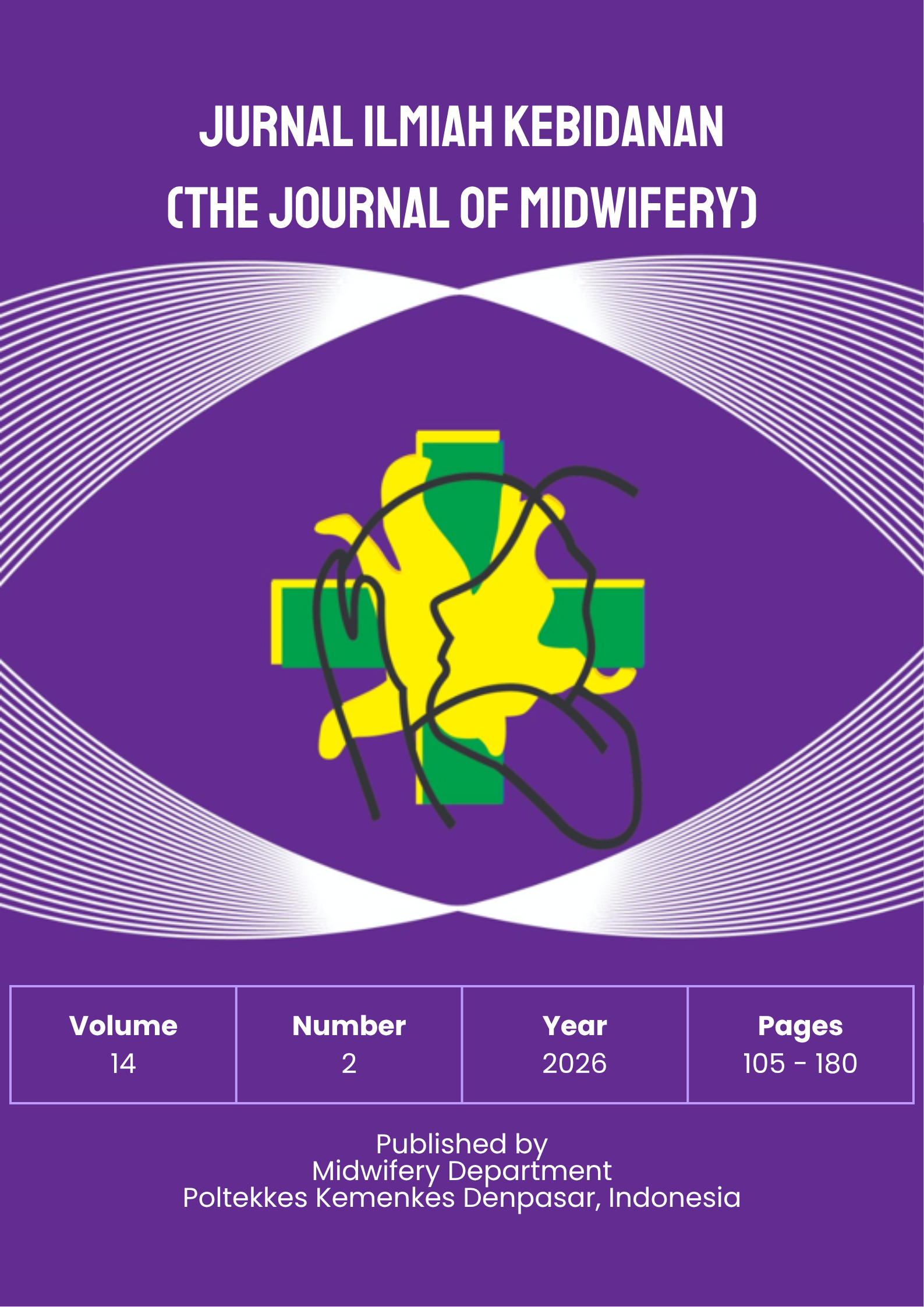
Jurnal Ilmiah Kebidanan (The Journal of Midwifery), Volume 14, Number 2 (2026) presents a collection of original research articles and a review article addressing contemporary issues in midwifery, maternal and neonatal health, adolescent reproductive health, and women's health.
This issue highlights various aspects of maternal healthcare, including antenatal care utilization, the influence of sociocultural factors on maternal health services, cesarean section delivery, postpartum lactation support, and the management of postpartum hypertension. It also explores adolescent health through studies on menstrual health, iron supplementation adherence, and the role of physical activity in reproductive health.
Additional contributions examine neonatal health outcomes, the utilization of maternal and child health handbooks, and the development of digital midwifery education to support innovation in healthcare. A review article further discusses the determinants of unmet family planning needs among women of reproductive age in developing countries.
Collectively, the articles in this issue provide valuable evidence to support evidence-based midwifery practice, strengthen maternal and child healthcare services, and encourage innovation in midwifery education and healthcare delivery.
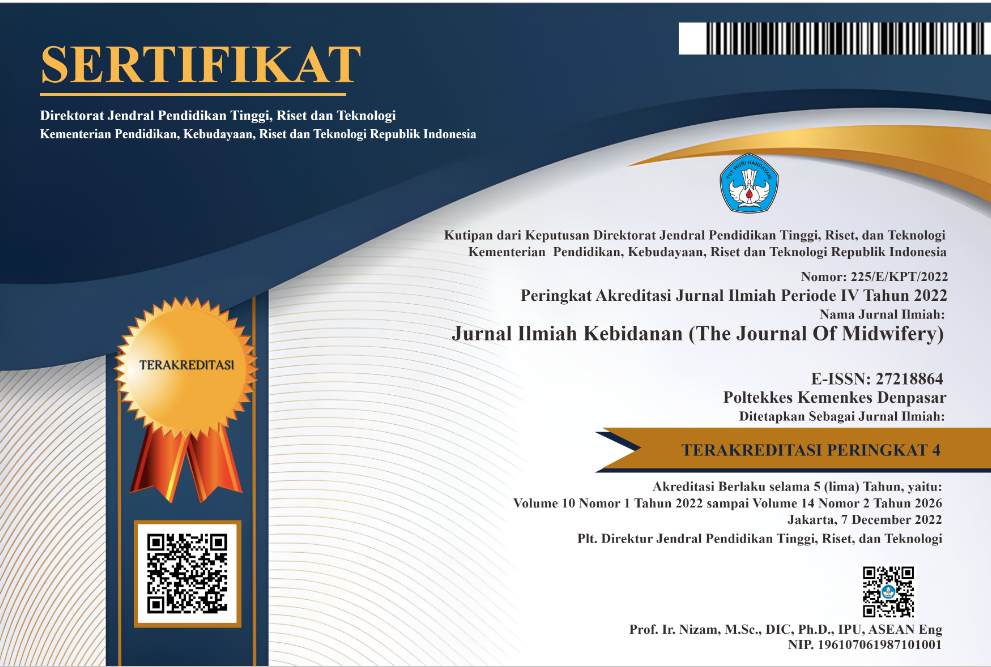
ACCREDITED
MANUSCRIPT TEMPLATE & REQUIRED FORM

ABOUT THE JOURNAL
PEOPLE
AUTHOR GUIDELINES
POLICIES & ETHICS
INDEXED IN




MAPS
Jurnal Ilmiah Kebidanan (The Journal of Midwifery) is published by the Midwifery Department, Poltekkes Kemenkes Denpasar
e-ISSN : 2721-8864 p-ISSN : 2338-669X
Email : jikpolkesden01@gmail.com
 This journal is licensed under a Creative Commons Attribution-ShareAlike 4.0 International License .