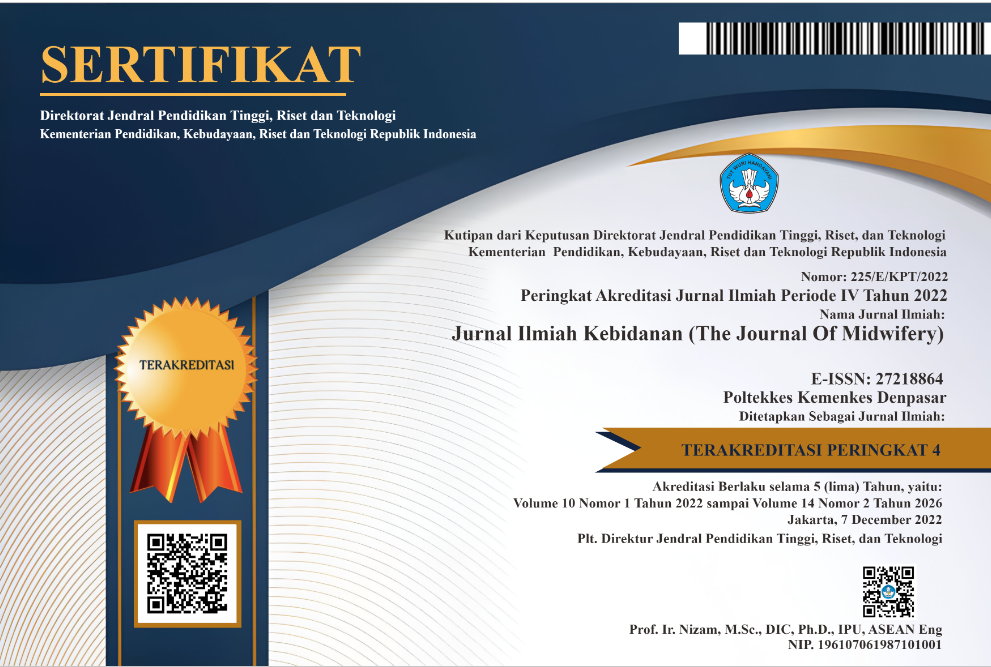
Jurnal Ilmiah Kebidanan (The Journal of Midwifery) is a scientific journal published by the Midwifery Department of Poltekkes Kemenkes Denpasar. The journal publishes research and scholarly articles in the field of midwifery and maternal health.
Authors who wish to submit manuscripts to this journal must ensure that their submissions comply with the journal’s scope, ethical standards, and formatting requirements. Manuscripts that do not meet these requirements may be returned to the authors before entering the peer-review process.
All manuscripts must be original works that have not been previously published and are not under consideration for publication in another journal.
Types of Manuscripts
The journal accepts the following types of manuscripts:
-
Original Research Articles – Reports of empirical research in midwifery, maternal health, neonatal health, or related public health topics.
-
Literature Reviews – Critical reviews of existing research that provide new insights into relevant topics.
Manuscript Format
Manuscripts must be prepared according to the following formatting requirements:
-
File format: Microsoft Word (.doc / .docx)
-
Font: Times New Roman
-
Font size: 11 pt
-
Line spacing: single spacing
-
Text alignment: justified
-
Paragraph indentation: 6 spaces
-
Maximum manuscript length: 12 pages
Authors are strongly encouraged to use the official journal template.
Manuscript Structure
Title
The title should be concise, informative, and clearly reflect the content of the manuscript.
The title should:
-
Be written in English
-
Contain 12–18 words
-
Use Times New Roman 14 pt, bold
-
Use capital letters at the beginning of each word
-
Be center aligned
Author Information
Author names must be written without academic degress.
Include:
-
Author names
-
Institutional affiliations
-
City and country
-
Corresponding author email
A phone number may be provided for administrative purposes but will not be published.
Abstract
The abstract must:
-
Be written in English
-
Be written in one paragraph
-
Contain a maximum of 200 words
-
Include:
-
Background
-
Objective
-
Methods
-
Results
-
Conclusion
-
The abstract must not include references, tables, or figures.
Keywords
Provide 3–5 keywords that represent the main topics of the article, written in English, and separated by semicolon (;).
Main Text
Introduction
The introduction should include:
-
Research background
-
State of the art of the study
-
Gap analysis from previous studies
-
Research objectives
Literature review should be presented as state-of-the-art discussion, not as a separate section.
Methods
The methods section must clearly explain:
-
Research design
-
Study location and time
-
Population and sampling method
-
Data collection instruments
-
Data analysis method
-
Ethical clearance information (if applicable)
Results and Discussion
This section presents research findings and scientific interpretation.
Results should:
-
Present the main findings clearly
-
Be supported by appropriate data
-
Be followed by scientific discussion
Authors should also compare their findings with previous studies.
Tables and Figures
Tables and figures must follow these rules:
Tables
-
Tables must be numbered sequentially (Table 1, Table 2, etc.)
-
Table titles must appear above the table
-
Font: Times New Roman 11
-
Tables should be clear and concise
-
Decimal numbers use comma (,) format.
Figures and Graphics
-
Figures must be numbered sequentially (Figure 1, Figure 2, etc.)
-
Figure titles must appear below the figure
-
Images must be clear and readable.
The total number of tables and figures should not exceed six.
Conclusion
The conclusion should summarize the main findings of the study and answer the research objectives or hypotheses.
The conclusion should not repeat the discussion, but instead highlight the main contributions of the study.
Acknowledgments
This section may be used to acknowledge:
-
Research funding sources
-
Institutional support
-
Individuals who contributed to the research
References
All references cited in the manuscript must appear in the reference list.
The reference list must follow these requirements:
-
Citation style: Vancouver Style
-
Minimum 10 references
-
At least 80% from scientific journals
-
Preferably published within the last 10 years
Authors are encouraged to use reference management software such as:
-
Mendeley
-
Zotero
-
EndNote
Plagiarism Screening
All submitted manuscripts will be checked for similarity using Turnitin.
Manuscripts with a high similarity index (more than 20%) may be rejected or returned to the authors for revision.
Ethical Considerations
Research involving human participants must comply with ethical research standards and must obtain approval from an appropriate ethics committee or institutional review board.
Authors must ensure that informed consent has been obtained when required and that the privacy and confidentiality of participants are protected.