Author Guidelines
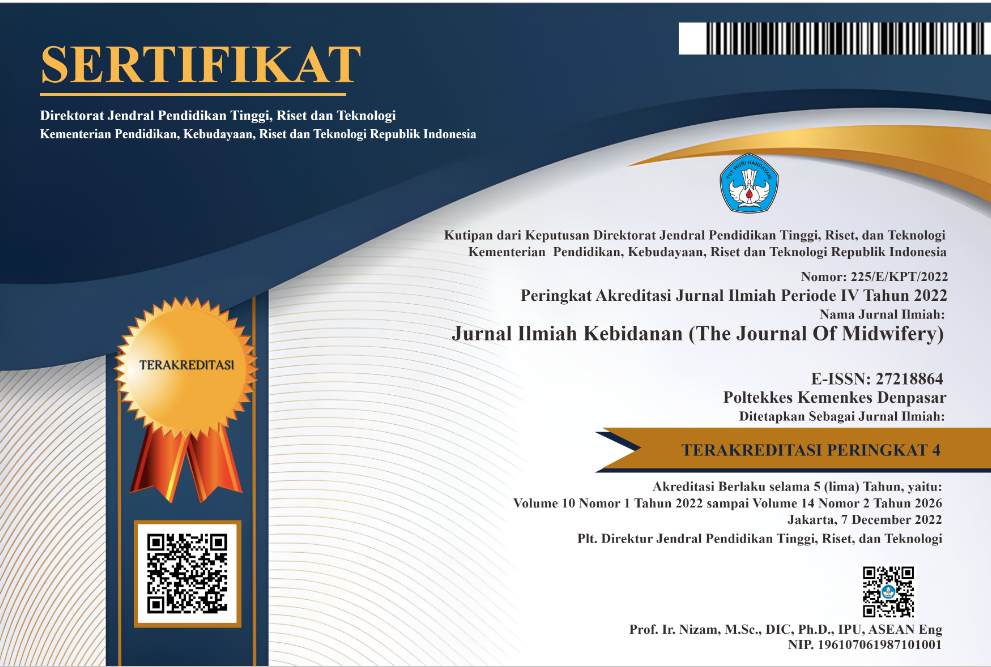
Jurnal Ilmiah Kebidanan (The Journal of Midwifery) is published by the Midwifery Department of Poltekkes Kemenkes Denpasar. The journal accepts manuscripts relevant to midwifery, maternal and neonatal health, reproductive health, and related fields.
Authors must comply with the journal’s scope, ethical standards, manuscript-type requirements, and submission instructions. Incomplete submissions will be returned for correction before editorial assessment or peer review.
Manuscripts must be original and must not be under consideration by another journal. Any related preprint, conference abstract, thesis, dissertation, or overlapping publication must be disclosed to the editor for assessment.
Table of Contents
- Types of Manuscripts and Requirements
- Manuscript Templates and Required Form
- Author Metadata and Submission Completeness
- Authorship and Contributorship
- General Manuscript Format
- Title and Author Information
- Abstract and Keywords
- Original Research and Review Articles
- Clinical Case Reports
- Letters to the Editor and Research Letters
- Tables, Figures, and Supplementary Material
- Acknowledgments and Declarations
- References and In-Text Citations
- Similarity Screening
- Ethical Considerations
- Submission Checklist
Types of Manuscripts and Requirements
- Original Research Articles: Full reports of original quantitative, qualitative, or mixed-methods research.
- Review Articles: Evidence syntheses, including systematic reviews, scoping reviews, and meta-analyses, with clearly described methods. Meta-analysis may form part of a systematic review.
- Clinical Case Reports: Educational reports of clinically relevant cases in midwifery care, with appropriate patient confidentiality and consent for publication.
- Letters to the Editor: Concise scholarly comments, critiques, or responses concerning articles published in the journal or relevant issues in midwifery.
- Research Letters: Brief reports of original research findings with a concise but sufficient description of the methods and results.
| Requirement | Original Research | Review | Clinical Case Report | Letter to the Editor | Research Letter |
|---|---|---|---|---|---|
| Maximum length | 12 pages | 15 pages | 8 pages | 3 pages | 5 pages |
| Abstract | Up to 300 words | Up to 300 words | Up to 300 words | Not required | Not required |
| Keywords | 3–5 | 3–5 | 3–5, including “case report” | Not required | Not required |
| References | At least 15 | At least 15 | At least 15 | At least 15 | At least 15 |
| Tables and figures combined | Up to 6 | Up to 6 | Up to 6, including the timeline | Up to 1 | Up to 2 |
Page limits apply to the complete main manuscript file, including title and author information, abstract where required, main text, tables, figures, declarations, and references. Separate administrative forms and supplementary files are excluded. Use the formatting specified below when calculating length. Supplementary files must not be used to omit information essential to understanding or assessing the manuscript.
All manuscript types must be written in English and use Vancouver referencing. Each manuscript must contain at least 15 references, and at least 80% of all references must be scientific journal articles published within the 10 years preceding submission.
Manuscript Templates and Required Form
Use the appropriate template. Download an editable copy or make a personal copy in Google Docs; do not request editing access to the master file. Remove all instructions, examples, unused sections, and template-only page breaks before submission.
- ???? Research and Review Article Template — for Original Research Articles and Review Articles.
- ???? Clinical Case Report Template — for Clinical Case Reports.
- ???? Letter and Research Letter Template — for Letters to the Editor and Research Letters.
- ???? Statement of Manuscript Authenticity — required for every manuscript type.
Complete the Statement of Manuscript Authenticity, obtain signatures from all authors, and upload it as a separate PDF file under the corresponding submission component. This statement does not replace ethics approval, participant consent, or patient consent for publication. It is an administrative document and is not intended for publication.
Author Metadata and Submission Completeness
The submitting author must add every author individually in the online submission system. Providing author information in the manuscript alone is not sufficient.
- Full name: use each author’s publication name without academic titles. Names and author order must match the manuscript.
- Email: provide an active email address belonging to each author. Do not use the submitting author’s email as a substitute for co-authors’ addresses.
- Affiliation: provide the department or program where applicable, institution, city, and country for each author.
- Country: complete the country field for every author.
- ORCID iD: authors are encouraged to provide their own valid ORCID iD and connect it through the system’s authentication facility where available. Never enter another person’s ORCID iD.
- Corresponding author: clearly identify the author responsible for editorial communication and provide an active telephone number through the submission system or confidential administrative communication. Telephone numbers will not be published.
Confirm all author information with the co-authors before submission. Also complete the manuscript title, abstract and keywords where required, and other applicable submission fields.
The editorial office checks the manuscript, required form, and metadata before forwarding the submission for editorial assessment. Incomplete or inconsistent submissions will be returned for correction and will not proceed until the required information has been completed and verified. Updating the manuscript file alone does not correct submission metadata.
Authorship and Contributorship
The journal follows the ICMJE authorship recommendations. Each author must satisfy all four conditions:
- Make a substantial contribution to the design or conception of the work, or to obtaining, analyzing, or interpreting its data.
- Draft the manuscript or critically revise its intellectual content.
- Approve the version to be published.
- Accept accountability for the work and cooperate in resolving concerns about its accuracy or integrity.
Acknowledge contributors who do not meet all four conditions, with their permission. The corresponding author must ensure that all authors approve submission and revisions. Requests to add, remove, or reorder authors require an explanation and written agreement from all affected authors, including anyone being added or removed, and are subject to editorial assessment. AI tools cannot be authors.
General Manuscript Format
- File: Microsoft Word (.doc or .docx), preferably .docx.
- Language: English.
- Paper: A4; side margins 2.5 cm; top and bottom margins 2 cm.
- Body font: Times New Roman, 11 pt, single spacing, justified.
- Paragraphs: first-line indent of 0.5 cm, set using paragraph settings rather than spaces or tabs. Do not indent headings, abstracts, captions, or reference entries.
- Main headings: bold uppercase, 11 pt, aligned left, without numbering.
- Subheadings: bold sentence case, 11 pt, aligned left, without numbering.
- Footer: automatic page numbers. Publication headers, volume and issue information, DOI, article history, final citation, and copyright or license statements will be added during production.
Title and Author Information
Title
Use a concise, informative English title in sentence case, bold Times New Roman 14 pt, centered. Aim for 12–18 words for Original Research, Review, and Clinical Case Reports; additional words are acceptable when needed to identify the design or clinical focus. Letters should use a concise title appropriate to their content.
Identify the review type in review titles, such as “a systematic review,” “a scoping review,” or “a systematic review and meta-analysis.” Include “a case report” in Clinical Case Report titles. For correspondence responding to a published article, “Comment on” or “Response to” may be used.
Author information
List names without degrees in bold, 11 pt. Link authors to affiliations with superscript numbers and mark the corresponding author with an asterisk. Provide affiliations in italic, 10 pt, including department where applicable, institution, city, and country. Include the corresponding author’s name and email address. The corresponding author need not be the first author. Do not place telephone numbers in the manuscript.
Abstract and Keywords
Original Research and Review Articles: provide a single-paragraph abstract of no more than 300 words containing Background, Objective, Methods, Results, and Conclusion in sequence. Separate subheadings are not required. For original research, summarize design, participants or data sources, analysis, and principal findings. For reviews, report the review type, eligibility criteria, information sources, last search date, synthesis methods, number of included studies, and main findings. Include important limitations and registration information where applicable. Systematic review abstracts should address the applicable PRISMA for Abstracts items.
Clinical Case Reports: provide a single-paragraph abstract of no more than 300 words covering Background, Case presentation, and Conclusion. Describe the educational value, main assessment and intervention, outcome, and principal lesson. Separate subheadings are not required.
Letters to the Editor and Research Letters: abstracts and keywords are not required.
Abstracts must not include references, tables, figures, undefined abbreviations, or information absent from the main manuscript. Use Times New Roman, 11 pt, without first-line indentation.
For manuscript types requiring keywords, provide 3–5 English keywords or phrases separated by semicolons. Use MeSH terms where suitable. Include “case report” among the keywords for Clinical Case Reports.
Original Research and Review Articles
Use separate sections: Introduction; Methods; Results; Discussion; Conclusion; followed by acknowledgments where applicable, declarations, references, and supplementary material where applicable.
Introduction
Explain the background, relevant current knowledge, gap in evidence or practice, and relevance to the journal’s field. End with explicit objectives or questions. Include hypotheses only where appropriate. For reviews, explain why a new review is needed in relation to existing reviews. Integrate literature into the introduction rather than adding a separate thesis-style literature review chapter.
Methods for Original Research
Describe the design, setting, study period, eligibility criteria, recruitment and sampling, sample-size justification where relevant, variables or focus of inquiry, data sources, instruments, collection procedures, and analysis. Report instrument validity and reliability where relevant. Identify software and versions where applicable.
Explain approaches to bias and, for qualitative work, reflexivity and trustworthiness. For mixed-methods research, explain integration of the components. Report registration where applicable and summarize ethical safeguards. Use the reporting guideline appropriate to the design.
Methods for Review Articles
Specify the review type, objective, eligibility criteria and justified restrictions, information sources, search dates, and selection and extraction or charting procedures. Explain reviewer independence and disagreement resolution. Provide complete database search strategies as supplementary material. State protocol availability, registration or absence of registration, and relevant amendments.
Describe risk-of-bias or critical-appraisal methods where applicable and explain synthesis or evidence-mapping methods. For meta-analysis, specify effect measures, models, heterogeneity assessment, and any subgroup, sensitivity, reporting-bias, or certainty-of-evidence assessments undertaken. Do not imply that every review requires meta-analysis. For scoping reviews, explain critical appraisal if undertaken; it is not mandatory for every scoping review.
Systematic reviews should follow PRISMA 2020 and relevant extensions. Scoping reviews should follow PRISMA-ScR. Using a flow diagram alone does not establish that a review is systematic.
Results
Report findings in relation to the objectives without extensive interpretation. For original research, present sample characteristics and principal results, including effect estimates and uncertainty where appropriate, qualitative themes with supporting evidence, or integrated mixed-methods findings.
For reviews, report selection results, full-text exclusions and reasons, an appropriate flow diagram, characteristics of included evidence, and synthesis or mapping results. Report appraisal, meta-analysis, and certainty assessments when undertaken. Avoid duplicating all table and figure contents in the text.
Discussion
Interpret the principal findings, compare them with relevant evidence, explain strengths and limitations, and discuss implications for practice, education, policy, or further research. For reviews, distinguish limitations of the included evidence from limitations of the review process. Avoid unsupported causal claims and recommendations beyond the evidence.
Conclusion
Answer the objectives concisely and state the principal implication. Do not introduce new findings or repeat detailed results.
Clinical Case Reports
Follow the CARE reporting checklist and use the following structure:
- Introduction: explain the clinical context, educational value, and purpose.
- Case Presentation: present the case chronologically using subheadings for Patient information; Clinical findings; Timeline; Diagnostic assessment; Therapeutic interventions and midwifery care; Follow-up and outcomes.
- Discussion: compare the case with relevant evidence, explain clinical reasoning, limitations, and lessons for practice. Do not establish causation or treatment effectiveness from a single case.
- Patient Perspective: where feasible, include the patient’s experience with permission. A parent or authorized representative may contribute for a neonatal case. If unavailable, briefly explain why.
- Conclusion: state the main lesson supported by the observations.
- Acknowledgments and declarations; References; Supplementary material where applicable.
Include a timeline table or figure within the six-item combined limit. Use relative dates where possible. Describe clinically relevant maternal and neonatal findings and outcomes separately where applicable. Obtain written consent for publication covering each individual whose information is reported, as applicable, and include a Consent for Publication statement.
Letters to the Editor and Research Letters
Letters to the Editor
Begin with “To the Editor,” and present a concise scholarly argument without mandatory research-section headings. Identify and cite the article being discussed in the opening paragraph where applicable. Support the argument with relevant evidence, maintain a respectful tone, and end with a constructive implication, recommendation, or question. Author responses should address the substantive points raised. Follow with acknowledgments where applicable, declarations, and references.
Correspondence must not be used to bypass requirements for reporting original research. Reports of new systematic data collection and analysis should use the Research Letter format.
Research Letters
Use Introduction; Methods; Results; Discussion; followed by acknowledgments where applicable, declarations, and references. No separate Conclusion heading is required; end the Discussion with a concise conclusion.
Briefly state the research question; report design, setting, participants or data sources, sampling, collection, analysis, and ethical safeguards; present principal findings; and discuss interpretation and limitations. Provide enough methodological detail to assess validity. Use supplementary methods where needed without omitting essential information from the main text.
Tables, Figures, and Supplementary Material
Follow the category-specific combined limits above. Number tables and figures separately in order of first citation and place them near the relevant text. Table titles go above tables; figure captions go below figures. Use sentence case, readable fonts, and clear units. Define abbreviations and statistical symbols in footnotes or captions.
Use decimal points. Report statistical tests where relevant and use “p < 0.001” rather than “p = 0.000.” Do not duplicate the same data unnecessarily across text, tables, and figures. Cite sources of adapted or reproduced material and obtain permission where required.
Label supplementary files clearly and cite each in the manuscript. Suitable files include detailed search strategies, reporting checklists, extraction tables, instruments, and additional analyses. Requests to exceed main-text table or figure limits must be justified in the cover letter. Do not upload signed patient consent forms or identifiable confidential records as public supplementary material.
Acknowledgments and Declarations
Place the following sections after the main text and before References. Include the declaration headings below and use an accurate “Not applicable” statement where appropriate. Acknowledgments may be omitted if there are none.
Acknowledgments
Describe assistance from contributors who do not qualify for authorship and obtain permission before naming individuals. Report financial support under Funding.
Ethics Approval and Consent to Participate
For participant research or identifiable human data, provide the ethics committee, approval number and date where available, and consent procedures. Explain waivers and identify the responsible authority. State and explain when approval or participation consent was not required under applicable institutional requirements; do not assume that every case report is exempt. For case reports, this heading may be “Ethics Approval,” with publication consent reported separately.
Reviews using only published non-identifiable data and correspondence containing no new participant data should explain non-applicability accurately.
Consent for Publication
For all Clinical Case Reports and other manuscripts containing individual information requiring publication consent, confirm written informed consent from the patient or authorized representative, as applicable. Consent for care or research participation does not substitute for consent to publish. If not applicable, state “Not applicable.” Retain documentation securely and provide evidence through a secure editorial process if requested.
Conflicts of Interest
Disclose relevant financial and non-financial relationships. If none exist, state: “The authors declare no conflicts of interest.”
Funding
Identify financial support, grant numbers where applicable, and the funder’s role in the work and publication decision. If accurate, state: “This work received no specific grant from any funding agency in the public, commercial, or not-for-profit sectors.”
Data Availability
Explain where supporting data and materials can be accessed, including repository links where available, or explain restrictions. For reviews, address extracted or charted data and relevant analysis materials. For case reports, protect confidential clinical records. Do not promise access unless sharing is permitted. For correspondence without new data, an appropriate statement is: “No new data were generated or analyzed for this correspondence.”
Declaration of Artificial Intelligence Use
Disclose generative AI or AI-assisted tools used in conducting the work or preparing the manuscript. Identify the tool, provider, model or version where available, purpose, and verification procedures. Describe AI use affecting searching, screening, extraction, analysis, or figures in the relevant Methods section as well. Authors remain responsible for accuracy, originality, confidentiality, and references; AI tools cannot be authors.
If accurate, state: “No generative artificial intelligence or AI-assisted tools were used in conducting this work or preparing the manuscript.”
Author Contributions
A contribution statement is mandatory for every manuscript, including single-author manuscripts. Identify authors by initials and describe actual contributions using relevant CRediT roles. For reviews, identify relevant contributions to searching, screening, extraction or charting, appraisal, and synthesis. For letters, describe development of the argument, evidence review, and writing as applicable. All authors must approve the statement and final manuscript and accept accountability.
References and In-Text Citations
Every manuscript type requires at least 15 references. At least 80% of all references must be scientific journal articles published within the 10 years preceding manuscript submission. Relevant foundational studies and other sources may be included within the remaining proportion. Prioritize relevant journals indexed in Scopus, Web of Science, DOAJ, or SINTA while assessing the relevance and quality of individual sources.
For reviews, cite all included studies or sources of evidence. State and justify any publication-date eligibility restrictions in Methods. Consider the journal’s reference requirements when defining the review scope; do not omit eligible studies or their citations simply to meet the reference proportion. Discuss any genuine conflict between the review scope and these requirements with the editorial office before submission.
Use Vancouver referencing with superscript Arabic numerals without brackets. Number sources by first citation and reuse the same number for subsequent citations. Every listed entry must be cited, and every citation must have a corresponding reference entry.
Use standard journal abbreviations where available, add DOIs when assigned, and verify all names, titles, publication details, DOIs, and URLs against original sources. Never invent bibliographic details. Mendeley, Zotero, EndNote, or similar software is recommended. Format references in Times New Roman, 11 pt, single spacing, with a 0.5 cm hanging indent.
Example of in-text citation: Breastfeeding has many benefits1. Previous studies showed similar results2,3.
The following illustrate formats only; replace bracketed fields with verified information:
- Journal article: Author AA, Author BB. Article title. Abbreviated Journal Title. Year;volume(issue):page range or article number. doi:[DOI]
- Book: Author AA. Book title. Place of publication: Publisher; year.
- Online report or website: Author or organization. Title [Internet]. Place of publication: Publisher; year [cited YYYY Mon DD]. Available from: [URL]
- Thesis: Author AA. Title [thesis or dissertation]. Place: Institution; year.
- Conference paper: Author AA. Paper title. In: Editor AA, editor. Proceedings title; conference dates; conference location. Place: Publisher; year. p. [page range].
Similarity Screening
The journal conducts similarity screening using Turnitin during the initial editorial assessment, before peer review. Authors are not required to submit a similarity report with the initial submission.
A similarity index above 20% prompts further editorial assessment and may lead to a request for clarification or revision, or rejection where substantial inappropriate overlap is identified. The editor evaluates the source, extent, and context of overlap rather than relying on the percentage alone. A score of 20% or lower does not establish originality or guarantee acceptance.
The journal retains the screening report and editorial assessment with the submission record. Rechecking may be conducted after revision where necessary. Similarity reports are administrative records and are not published as article supplementary material.
Ethical Considerations
Research involving people or identifiable human data must comply with applicable ethical and institutional requirements. Obtain ethics approval and informed consent where required, or explain an authorized waiver. Report the applicable arrangements transparently.
Protect confidentiality in manuscripts, figures, metadata, and supplementary files. Remove names, initials, record numbers, unnecessary identifying details, and identifying image metadata. Use relative dates where possible for case reports. Do not fabricate or alter clinical facts to conceal identity.
Clinical Case Reports require written consent for publication. Where maternal and neonatal information is reported, ensure that the consent arrangements cover each individual as applicable. The Statement of Manuscript Authenticity is an author declaration and does not replace patient consent.
Submission Checklist
Before completing submission, confirm that:
- The manuscript fits the journal’s scope, is original, is not under consideration elsewhere, and any related dissemination has been disclosed.
- The appropriate template has been used, all instructional text has been removed, and category-specific length, abstract, keyword, and table or figure requirements have been met.
- Every author has been added individually to the submission system with accurate name, active email, affiliation, and country; names and order match the manuscript; ORCID iDs supplied belong to the authors concerned.
- The corresponding author has been identified and confidential telephone contact details have been provided.
- All authors have approved submission and the Statement of Manuscript Authenticity has been completed, signed by all authors, and uploaded as a separate PDF.
- Applicable ethics, consent, conflicts of interest, funding, data availability, AI use, and author contribution statements have been included.
- The manuscript contains at least 15 references and meets the requirement that at least 80% are scientific journal articles published within the preceding 10 years.
- Supporting files are clearly labeled and contain no information that should not be disclosed.
Administrative completeness does not guarantee acceptance. Once the submission is complete, the editor assesses scope, quality, ethical compliance, and similarity findings before deciding whether to proceed to peer review.