ANALYSIS OF PLATELET-LYMPHOCYTE RATIO IN TYPE 2 DIABETES MELLITUS AS A SYSTEMIC INFLAMMATION BIOMARKER
DOI:
https://doi.org/10.33992/meditory.v14i1.4056Keywords:
Diabetes Mellitus, Platelet Lymphocyte Ratio, Inflammation BiomarkerAbstract
Background: Chronic hyperglycemia in type 2 DM causes chronic low-grade systemic inflammation, which triggers complications. The body responds with an increase in proinflammatory cytokines and changes in blood cell hemostasis. The platelet lymphocyte ratio (PLR) is a new inflammatory marker that has clinical prognostic value.
Objective: Comparison of PLR values in type 2 DM without complications with the cardiovascular and nephropathy complication groups.
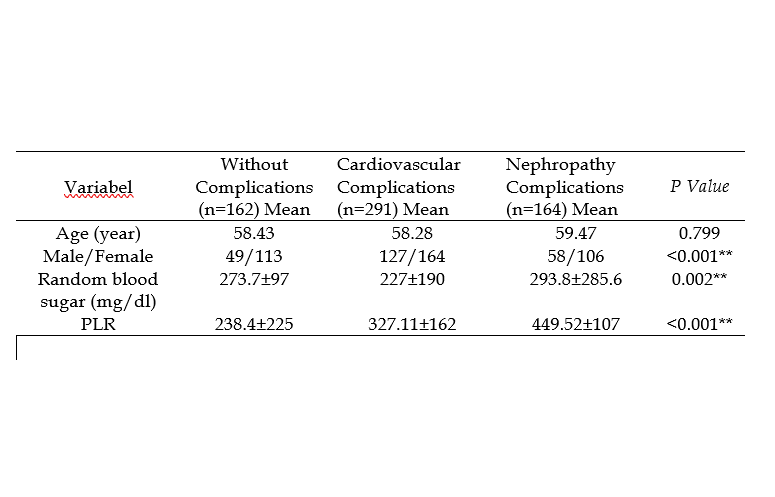
Methods: The study employed a retrospective research design and included a total of 617 respondents with type 2 DM. The respondents were divided into three groups: 162 with uncomplicated type 2 DM, 291 with cardiovascular complications, and 164 with nephropathy. The data was collected from Mojowarno Christian General Hospital in Jombang.
Results: The mean value of PLR in uncomplicated type 2 DM was 238.4 ± 225, in cardiovascular 327.11 ± 162, and in nephropathy 449.52 ± 107. The difference test yielded a statistically significant result p < 0.001, indicating that there were notable differences in PLR values across the three type 2 DM groups.
Conclusions: There is a difference in PLR values in type 2 DM between the group without complications and the group with complications (cardiovascular and nephropathy).
References
1. World Health Organization. Diagnosis and management of type 2 diabetes. Geneva: World Health Organization; 2020.
2. International Diabetes Federation. IDF Diabetes Atlas. 10th ed. Brussels: International Diabetes Federation; 2021 [cited 2026 Jul 17]. Available from: https://diabetesatlas.org/
3. Lim S, Bae JH, Kwon HS, Nauck MA. COVID-19 and diabetes mellitus: from pathophysiology to clinical management. Nat Rev Endocrinol. 2021;17(1):11-30. doi:10.1038/s41574-020-00435-4.
4. Okdahl T, Wegeberg AM, Pociot F, Brock B, Størling J, Brock C. Low-grade inflammation in type 2 diabetes: a cross-sectional study from a Danish diabetes outpatient clinic. BMJ Open. 2022;12(12):e062188. doi:10.1136/bmjopen-2022-062188.
5. Nugroho FA, Kusumastuty I, Cempaka AR, Latif ANH. The three month's dietary brown rice intervention has not significantly decreased levels of CRP, TNF-α, and IL-6 of type 2 diabetes mellitus patients. Healthc Low Resour Settings. 2023;11:11674. doi:10.4081/hls.2023.11674..
6. Huang M, Wang L, Zhang Q, Zhou L, Liao R, Wu A, Wang X, Luo J, Huang F, Zou W, Wu J. Interleukins in platelet biology: unraveling the complex regulatory network. Pharmaceuticals (Basel). 2024;17(1):109. doi:10.3390/ph17010109.
7. Poznyak AV, Khotina VA, Postnov AY, Sukhorukov VN, Sadykhov NK, Orekhov AN. Two forms of C-reactive protein and their implication for atherogenesis: focus on monomeric form. J Angiother. 2024;8(1):1-19.
8. Yang X, Yu Y, Xu J, Shu H, Xia J, Liu H, et al. Clinical course and outcomes of critically ill patients with SARS-CoV-2 pneumonia in Wuhan, China: a single-centered, retrospective, observational study. Lancet Respir Med. 2020;8(5):475-81. doi:10.1016/S2213-2600(20)30079-5.
9. Liu D, Czigany Z, Heij LR, Lang SA, Ulmer TF, Bednarsch J, et al. The value of platelet-to-lymphocyte ratio as a prognostic marker in cholangiocarcinoma: a systematic review and meta-analysis. Cancers (Basel). 2022;14(2):438. doi:10.3390/cancers14020438.
10. Zeng J, Chen M, Feng Q, Wan H, Wang J, Yang F, Chen H. The platelet-to-lymphocyte ratio predicts diabetic retinopathy in type 2 diabetes mellitus. Diabetes Metab Syndr Obes. 2022;15:3617-26. doi:10.2147/DMSO.S388638.
11. Jaaban M, Zetoune AB, Hesenow S, et al. Neutrophil-lymphocyte ratio and platelet-lymphocyte ratio as novel risk markers for diabetic nephropathy in patients with type 2 diabetes. Heliyon. 2021;7(7):e07564. doi:10.1016/j.heliyon.2021.e07564.
12. Sönmezöz GB, Yılmaz M. Association of neutrophil-lymphocyte ratio, platelet-lymphocyte ratio and monocyte-to-high-density lipoprotein ratio with diabetic nephropathy. Ther Apher Dial. 2025;29(3):428-36.
13. Meloni A, Cadeddu C, Cugusi L, Donataccio MP, Deidda M, Sciomer S, et al. Gender differences and cardiometabolic risk: the importance of the risk factors. Int J Mol Sci. 2023;24(2):1588. doi:10.3390/ijms24021588.
14. Putradi H, Susanto CS. The platelet-to-lymphocyte ratio on acute complication of diabetes mellitus. Indones J Clin Pathol Med Lab. 2019;25(3):353-7.
15. Wang H, Li L, Ma Y. Platelet-to-lymphocyte ratio: a potential prognosticator in acute myocardial infarction: a prospective longitudinal study. Clin Cardiol. 2023;46(6):632-8. doi:10.1002/clc.24015.
16. Onalan E, Gozel N, Donder E. Can hematological parameters in type 2 diabetes predict microvascular complication development? Pak J Med Sci. 2019;35(6):1511-5. doi:10.12669/pjms.35.6.1150.
17. Mineoka Y, Ishii M, Hashimoto Y, et al. Platelet-to-lymphocyte ratio correlates with diabetic foot risk and foot ulcer in patients with type 2 diabetes. Endocr J. 2019;66(10):905-13. doi:10.1507/endocrj.EJ19-0179.
Downloads
Published
Issue
Section
Citation Check
License
Copyright (c) 2026 FATHUL HIDAYATUL HASANAH

This work is licensed under a Creative Commons Attribution-ShareAlike 4.0 International License.
- Articles published in Meditory are licensed under Creative Commons Attribution-ShareAlike 4.0 International license. You are free to copy, transform, or redistribute articles for any lawful purpose in any medium, provided you give appropriate credit to the original author(s) and Meditory, link to the license, indicate if changes were made, and redistribute any derivative work under the same license.
- Copyright on articles is retained by the respective author(s), without restrictions. A non-exclusive license is granted to Meditory to publish the article and identify itself as its original publisher, along with the commercial right to include the article in a hardcopy issue for sale to libraries and individuals.
- By publishing in Meditory, authors grant any third party the right to use their article to the extent provided by the Creative Commons Attribution-ShareAlike 4.0 International license.